The AI market is exploding, most deployments fail, and the difference between the winners and the wasted budgets comes down to one thing: how you choose your tools.
Let's start with something you already suspect: you have too many AI tools, and you're not sure which ones are actually earning their keep.
Maybe marketing signed up for one writing assistant, sales quietly bought another, and someone in ops is running a third through a free trial that auto-renewed last month. Everyone means well. Everyone is "using AI." And yet, when someone asks whether all of it is actually moving the numbers, the room goes quiet.
That silence is the problem this guide is about. Not whether your business should use AI that ship has sailed but how you decide which AI tools to adopt, keep, and drop. That decision-making process is what we mean by an AI tool selection strategy, and over the next few pages we'll make the case that it's about to become as essential as having a budget or a hiring plan.
The one-line version Buying AI tools is easy and cheap. Choosing the right ones and cutting the rest is where the money is actually made or lost. A selection strategy is simply the repeatable way you make that choice. |
The AI Gold Rush Nobody Warned You About
The scale of what's happening is genuinely hard to overstate. The global AI market sat at roughly $391 billion in 2025 and is forecast to reach around $3.5 trillion by 2033. The narrower AI tools market alone, the writing assistants, coding copilots, image generators, and analytics helpers your team actually clicks on was valued at about $68.5 billion in 2025 and is projected to hit $286 billion by 2033.
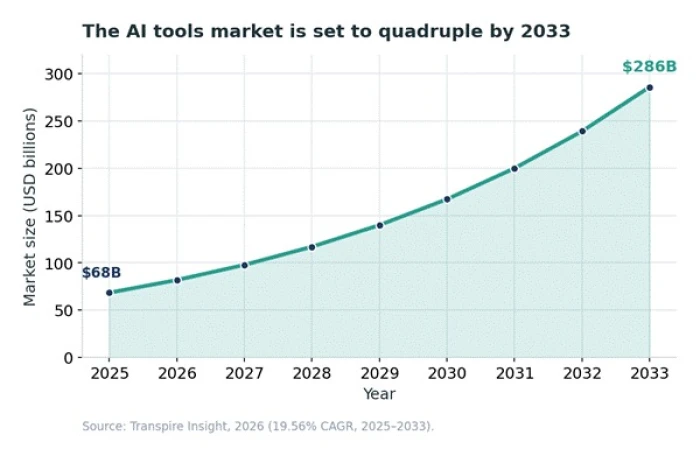
Figure 1 — The AI tools market is projected to grow at roughly 19.6% per year through 2033.
Here's the part that turns growth into chaos: one 24-month study tracked 9,531 AI tools across 170+ categories. Nearly nine out of ten visits went to just 100 of them, meaning the other 9,400+ are all competing for your attention, your free trials, and your credit card. New tools launch every single week, each promising to be the one that changes everything.
Adoption has kept pace. Around 88% of enterprises now use AI in at least one business function, and Microsoft reported over 400 million paid Copilot users by early 2026. AI has quietly become infrastructure. The question is no longer whether to adopt, it's how to adopt without drowning.
The Uncomfortable Truth About All That Spending
If adoption were the same as success, every company would be thriving. It isn't. When researchers actually measured outcomes, the picture got grim fast.
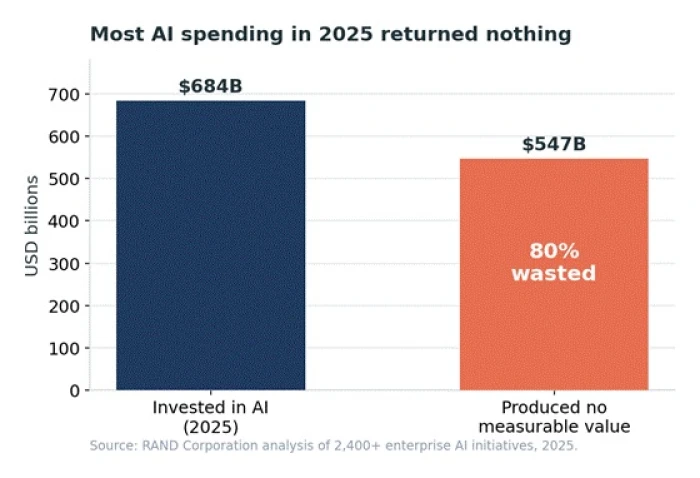
Figure 2 — Of the money enterprises poured into AI in 2025, roughly 80% produced no measurable business value.
RAND Corporation analysed more than 2,400 enterprise AI initiatives and found that 80.3% of AI projects fail to deliver their intended business value about twice the failure rate of ordinary, non-AI technology projects. In money terms: of an estimated $684 billion invested globally in 2025, over $547 billion produced no measurable results. Not weak returns. None.
And companies are noticing. The share that abandoned most of their AI initiatives jumped from 17% in 2024 to 42% in 2025. That's not a rounding error, that's a wave of organisations quietly walking away from tools they were enthusiastic about twelve months earlier.
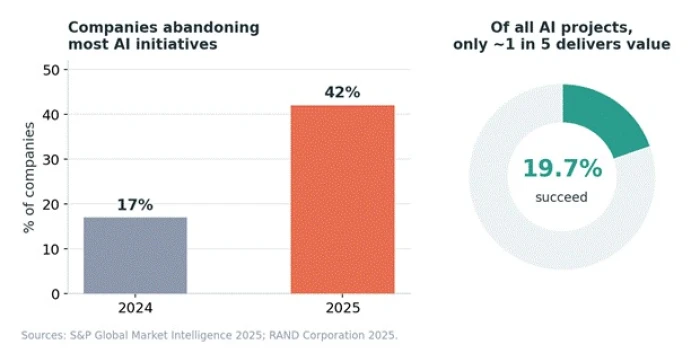
Figure 3 — Abandonment more than doubled in a year, and only about one in five projects delivers real value.
Why this matters for you The failures above weren't caused by bad AI. They were caused by choosing the wrong tools for the wrong problems, with no clear way to tell success from noise. That is precisely what a selection strategy prevents. |
What Actually Goes Wrong
It's tempting to blame the technology, but the research is remarkably consistent: the technology is almost never the culprit. The failures cluster around how tools get chosen and rolled out.
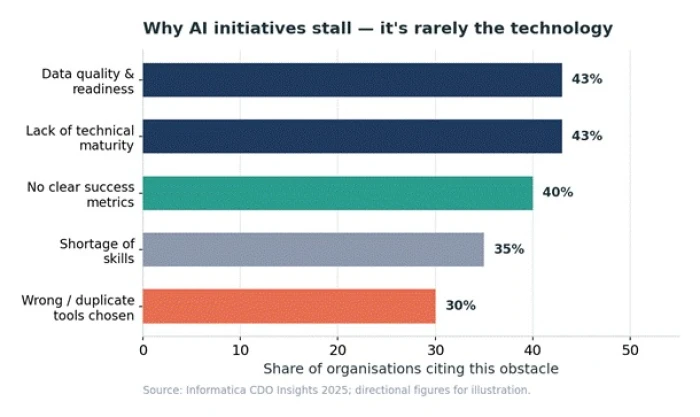
Figure 4 — The leading obstacles to AI success are organisational and strategic, not technical.
Broadly, botched AI adoption falls into a handful of repeatable patterns. Once you can name them, you can design a selection process that dodges each one:
| Failure pattern | What it looks like in practice | The real cost |
| Shiny-object buying | A tool gets bought because it's trending, not because it solves a defined problem. | Subscriptions nobody uses |
| Tool sprawl | Five teams buy five overlapping tools; data and workflows fragment. | Duplicate spend + confusion |
| No success metric | Nobody defined what "working" means, so results can't be judged. | Endless pilots, no decisions |
| Weak data readiness | The tool is fine; the data feeding it is messy or siloed. | Poor output, lost trust |
| Security blind spots | Sensitive data flows into an unvetted tool with no governance. | Compliance & breach risk |
| Lock-in by accident | Deep integration before evaluation makes switching painful. | Stuck paying for the wrong tool |
Notice the theme: every one of these is a decision problem, not a software problem. That's genuinely good news, because decisions are something you can systematise.
So What Exactly Is an AI Tool Selection Strategy?
Think of it as a lightweight, repeatable filter that every proposed AI tool has to pass through before it earns a place and a budget in your business. It doesn't need to be a 40-page document. It needs to answer a consistent set of questions the same way every time, so that choices are based on fit rather than hype.
A workable strategy usually covers five moving parts:
| Component | The question it answers | Owner |
| Problem definition | What specific job are we hiring this tool to do? | Team lead |
| Evaluation criteria | How will we score fit, cost, security, and ROI? | Ops / IT |
| Pilot & metrics | What does success look like in 30–60 days? | Team lead |
| Governance & security | Is our data safe, compliant, and well-governed? | IT / Legal |
| Review cadence | When do we re-check whether it still earns its keep? | Finance / Ops |
A Practical 6-Step Framework
Here's a sequence you can adopt this quarter without hiring a consultant. Run every candidate tool through these six steps:
1. Start with the problem, not the tool. Write one sentence describing the specific, measurable outcome you want (e.g. "cut first-draft time for blog posts by 50%"). If you can't, you're not ready to buy.
2. Shortlist against clear criteria. Score 2–3 candidates on the same scorecard rather than falling for the best marketing page.
3. Check data & security fit. Where does your data go, who can see it, and does it meet your compliance obligations? Non-negotiable gate.
4. Run a time-boxed pilot. Pick one team, set a 30–60 day window, and define the success metric before you start.
5. Decide with the numbers. Adopt, adjust, or drop based on whether the metric moved not on how much everyone liked the tool.
6. Review on a cadence. Re-evaluate the whole stack quarterly. Cancel what's coasting; the market will have better options by then anyway.
The 50–70% rule Winning AI programs invert the usual spending ratio: they put 50–70% of their time and budget into data readiness and clear definitions, and only the rest into the tool itself. If you're spending it the other way around, that's your warning sign. |
A Scorecard You Can Steal
When you reach step 2, score each candidate tool from 1 (poor) to 5 (excellent) on the criteria below, then weight them. Anything that fails the security gate is out regardless of its total score.
| Criterion | Weight | What a strong score looks like |
| Problem fit | 25% | Solves the exact job you defined, not a vague adjacency |
| Measurable ROI | 20% | You can point to time saved or revenue moved |
| Ease of adoption | 15% | Team can use it without weeks of training |
| Integration | 15% | Plays well with tools you already run |
| Security & compliance | Gate | Clear data handling; meets your obligations |
| Total cost of ownership | 15% | Includes seats, add-ons, and switching cost |
| Vendor stability | 10% | Likely to still exist and improve next year |
The Payoff: Strategy vs. No Strategy
None of this is busywork. The businesses that treat tool selection as a discipline look measurably different from those buying on impulse. Here's the contrast in plain terms:
| Dimension | Without a strategy | With a strategy |
| Tool spend | Creeps up, hard to trace | Deliberate, tied to outcomes |
| Adoption | Trials that quietly lapse | Tools the team actually uses |
| Measuring success | "It feels helpful" | Metrics moved or it's cut |
| Security | Ad-hoc, risky | Governed by default |
| Reaction to new tools | FOMO buying | Calm, criteria-based decisions |
| Result | Part of the 80% that waste | Part of the ~20% that win |
The winners aren't spending more, in fact, the correlation between AI spend and AI results is weak. They're choosing better. A selection strategy is how "choosing better" becomes a habit instead of a lucky streak.
Traps to Sidestep Along the Way
Confusing activity with progress. "We're using five AI tools" is not a result. Moving a metric is.
Letting every team buy independently. That's how sprawl and duplicate spend start. Centralise the decision, even lightly.
Skipping the pilot. A demo shows the best case; a pilot shows your case.
Never revisiting choices. The tool that won six months ago may be outclassed today. Review or overpay.
Treating security as paperwork. Where your data flows is a business risk, not a checkbox.
The Bottom Line
AI tools are multiplying faster than anyone can evaluate them, most deployments still fail, and the gap between the winners and everyone else comes down to how deliberately they choose. A selection strategy isn't bureaucracy, it's the cheapest insurance you can buy against joining the 80% who spend and get nothing back.
You don't need a big budget or a data-science team to start. You need one sentence describing the problem, one scorecard, one time-boxed pilot, and the discipline to cut what isn't working. Do that consistently, and "we use AI" turns into "AI is quietly making us money" which is the only version of this story worth being in.
Your next step Pick the single AI tool your team relies on most right now and run it back through the 6-step framework this week. If it can't clear your own scorecard, you've just found the first thing your new strategy should fix. |