The Great Unbundling of Artificial Intelligence
For a brief moment around 2023, the ambition of artificial intelligence was almost boundless. A single chat box promised to write your code, draft your contracts, plan your marketing, diagnose your symptoms and answer your children's homework, all from the same prompt window. The dominant question was not what can this tool do? but rather is there anything it cannot do? Three years on, the market has answered that question with a decisive and slightly counterintuitive verdict: the tools that win are the ones that deliberately choose to do less.
The industry is quietly unbundling the all-in-one assistant. In its place, a dense ecosystem of narrow, purpose-built tools is emerging, an AI that reads radiology scans but cannot write a limerick, a model that reviews commercial leases but knows nothing about SEO, an agent that reconciles invoices but has never seen a line of poetry. This is not a failure of ambition. It is the natural maturation of a technology moving from novelty to infrastructure, and the numbers behind the shift are striking.
THE CORE THESIS General-purpose models are becoming the electricity of AI, cheap, powerful and everywhere. But value is accruing to the appliances built on top of them: tools that embed one industry's data, rules and workflow so deeply that a generalist model cannot replicate the result, no matter how capable it becomes. |
From Generalist to Specialist: What Actually Changed
Two forces drove the pivot. First, foundation models became commoditised. When every major provider offers a broadly capable model at a similar price, being "good at everything" stops being a differentiator, it becomes table stakes. A product whose only feature is a thin wrapper around a general model has no defence the moment the model provider ships the same capability natively. Prompt-optimisation tools are the classic casualty: they went extinct almost overnight once models became good enough to improve their own prompts on request.
Second, and more importantly, enterprises discovered that access to AI is not the same as value from AI. Adoption is now nearly universal, yet the returns are concentrated in a tiny minority of organisations. That gap between plugging in a chatbot and actually changing a profit-and-loss line is precisely the space that specialised tools have rushed to fill.
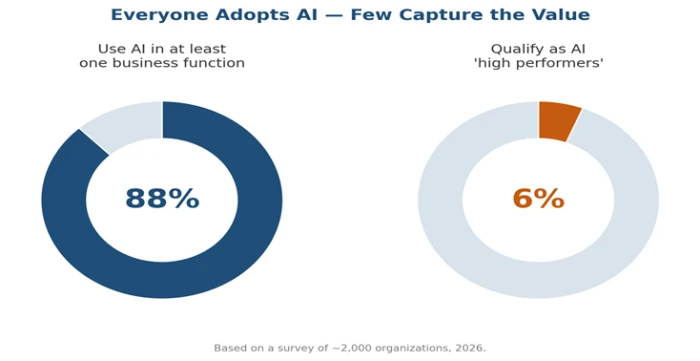
Figure 1 — Adoption is near-universal, but measurable value is not. Roughly 88% of organisations use AI in at least one business function, while only about 6% qualify as high performers with significant profit impact.
The lesson buyers took away was blunt: a tool that does one job inside their actual workflow beats a brilliant generalist that sits beside it. The market is now rewarding depth over breadth, and it is doing so with real money.
The Numbers Behind the Shift
The clearest evidence for specialisation is financial. The market for vertical AI, solutions purpose-built for a single industry or workflo has become one of the fastest-growing segments of the entire technology sector. Analysts value it at roughly USD 10.3 billion in 2025 and project it to reach about USD 74.5 billion by 2033, a compound annual growth rate near 28% that comfortably outpaces general enterprise software.
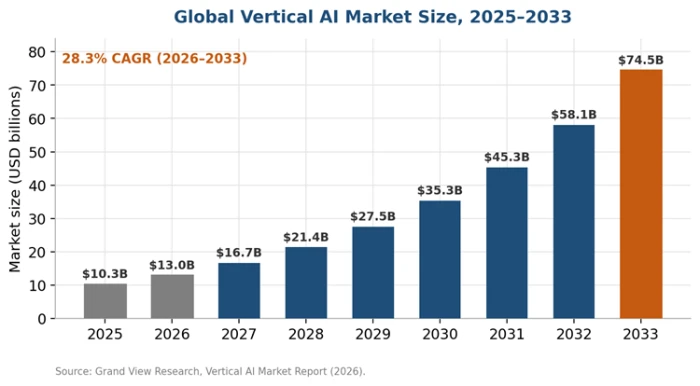
Figure 2 — The vertical AI market is projected to grow roughly seven-fold between 2025 and 2033. Figures are interpolated along the reported 28.3% CAGR; 2025, 2026 and 2033 are reported values.
A year-by-year view of the reported and modelled trajectory shows how compounding growth reshapes the market's scale over less than a decade:
| Year | Market size (USD) | Note |
|---|---|---|
| 2025 | ≈ $10.3 billion | Reported base year |
| 2026 | ≈ $13.0 billion | Reported |
| 2028 | ≈ $21.4 billion | Modelled along 28.3% CAGR |
| 2030 | ≈ $35.3 billion | Modelled along 28.3% CAGR |
| 2033 | ≈ $74.5 billion | Reported end-year forecast |
Table 1 — Vertical AI market size trajectory. Source: Grand View Research, Vertical AI Market Report (2026).
Growth is not evenly distributed. Within the AI-agent market, the specialised slices are compounding far faster than the generalist average. Domain-specific vertical agents are the single fastest-growing category, expanding at an estimated 62.7% CAGR — well above both multi-agent systems and the overall market.
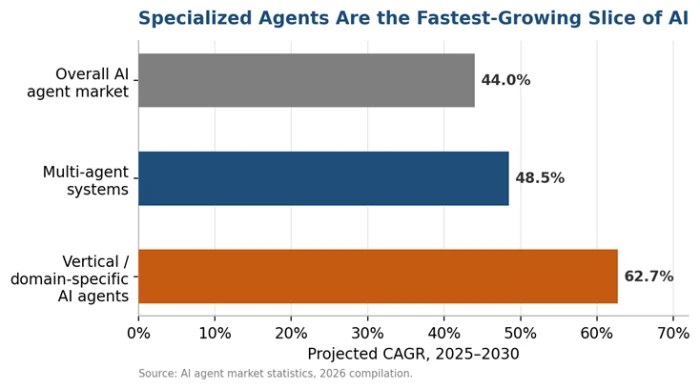
Figure 3 — The more specialised the agent, the faster the growth. Vertical, domain-specific agents lead the field on projected CAGR.
Adoption forecasts point the same way. Industry analysts expect that by the end of 2026 a large majority of enterprises on some estimates around 80% will have deployed at least one vertical, industry-specific AI agent, a figure that would have looked fanciful only two years ago.
Why Generality Became a Liability
For operationally intensive industries where a compliance failure costs millions, an hour of downtime halts a production line, or a diagnostic error risks a life being a generalist is no longer neutral. It is a liability. Four distinct pressures push tools toward specialisation.
1. Accuracy and hallucination
A general model trained on the open internet is, by design, a jack of all trades. When it answers a highly technical question, the tax treatment of a specific instrument, the dosing interaction between two drugs, its broad training becomes a weakness. Specialised tools narrow the domain, fine-tune on curated industry data, and constrain outputs to what the field actually permits. The result is materially higher accuracy and lower hallucination rates on the tasks that matter, which is the difference between a demo and a deployable product.
2. Compliance and regulation
Regulated industries do not simply want correct answers; they need answers produced through an auditable, compliant process. Healthcare, financial services, insurance and legal work all carry rules about data handling, explainability and record-keeping that a general chatbot has no concept of. A specialised tool bakes those requirements into its architecture, the compliance is a feature, not an afterthought, and that is something a horizontal model struggles to offer credibly.
3. Workflow integration
The deepest moat is rarely the model itself; it is where the tool sits. A generalist assistant answers a question and stops. A specialised tool is embedded in a multi-step process, it reads from the systems of record, acts, writes back the result, and hands off to the next step. Ripping it out means rebuilding the entire workflow, which is exactly why buyers tolerate a narrower feature set in exchange for something that actually fits how they work.
4. Cost efficiency
Running every task through a heavyweight frontier model is expensive. Specialised teams increasingly distil narrow tasks down to small, efficient models, a few billion parameters rather than hundreds running on lean inference infrastructure at a fraction of the token cost. For a high-volume, repetitive task, a purpose-built small model can be both cheaper and better than a giant generalist, an unusual combination that makes the economics hard to argue with.
Horizontal vs Vertical AI, Side by Side
The distinction between horizontal (general-purpose) and vertical (industry-specific) AI is the organising idea behind the whole shift. The two are not really competitors so much as different layers of the same stack, but their business characteristics diverge sharply:
| Dimension | Horizontal / General-Purpose AI | Vertical / Specialized AI |
|---|---|---|
| Scope | Works across any use case or industry | Built for one industry or workflow |
| Training data | Broad, open-web corpora | Curated, proprietary, domain-specific data |
| Accuracy on niche tasks | Variable; prone to plausible errors | High; tuned to the domain's rules |
| Compliance | Generic; bolted on afterward | Native, built into the architecture |
| Switching cost for buyers | Low — easy to replace | High — embedded in core workflows |
| Primary risk | Absorbed by model providers | Smaller total addressable market |
| Value capture | Competes for IT budget | Competes for the labour budget |
Table 2 — How the two approaches differ across the dimensions that decide who wins.
That last row is the quiet revolution. Horizontal tools fight over a slice of the IT budget. Vertical tools aim at something far larger, the labour line of the profit-and-loss statement. When a specialised tool can do the work of an expensive human process with higher accuracy, around the clock, it is no longer selling software; it is selling output. That reframing is why adoption is moving faster than anyone predicted.
Where Specialization Is Winning
Specialisation is not spreading evenly. It concentrates first in industries that are data-rich, tightly regulated, and full of high-value repetitive work, the exact profile where a generalist tool is weakest and a specialist's advantages compound.
| Industry | What specialized AI does | Why a generalist falls short |
|---|---|---|
| Healthcare | Clinical documentation, diagnostics support, revenue-cycle automation | Patient safety and privacy rules leave no margin for plausible-but-wrong output |
| Financial services | Fraud detection, underwriting, compliance monitoring | Auditability and regulation demand explainable, domain-tuned models |
| Legal | Contract review, clause extraction, matter research | Jurisdiction-specific nuance and citation accuracy are non-negotiable |
| Manufacturing | Predictive maintenance, quality inspection, scheduling | Downtime is measured in money per minute; generic advice is useless on the line |
| Retail / e-commerce | Demand forecasting, catalogue enrichment, pricing | Requires proprietary sales data and category-specific context |
Table 3 — Healthcare and financial services lead adoption today; regulated, high-stakes work is the natural home of specialization.
The Economics: Why Specialists Defend Their Turf
If a general model can, in principle, do almost anything, why can't it simply absorb every specialised tool? The answer is that a durable specialist is built on advantages a generalist cannot easily copy, commonly called moats. The strongest vertical products stack at least two of them:
| Moat | What it means in practice |
|---|---|
| Data moat | Access to proprietary data competitors cannot replicate; every customer interaction makes the product smarter. |
| Workflow moat | Embedded in a multi-step process with deep integrations, so removing it means rebuilding the whole operation. |
| Regulatory moat | Handles compliance, certification and audit requirements that demand specialised, hard-won domain knowledge. |
| Distribution moat | Owns the relationships, procurement channels and trust inside an industry that take years to build. |
Table 4 — The four moats. Products with none are wrappers; products with two or more are hard to dislodge.
The reasoning is simple. When a foundation-model provider ships a popular general feature natively, every thin wrapper built on that feature loses its reason to exist. But a tool protected by proprietary data, workflow lock-in and regulatory expertise is nearly impossible to replicate — the general model can supply the raw intelligence, yet it cannot supply the context that makes the intelligence useful in a specific industry.
The Counter-Argument: Don't Foundation Models Eat Everything?
It would be dishonest to present specialisation as an unqualified, permanent trend. There is a real counter-force, and any serious builder or buyer should weigh it.
• The absorption risk is genuine. Model providers have repeatedly swallowed popular use cases, coding help, image generation, basic writing assistance that were once standalone products. Anything a generalist can do "well enough" is a candidate for absorption.
• Some specialisation is temporary. A tool that exists only because today's models are slightly too weak at a task may vanish the moment the next model closes the gap. Specialisation built on a capability shortfall is fragile; specialisation built on data, workflow and regulation is durable.
• Generalists still dominate cross-industry work. For email, scheduling, brainstorming and general collaboration, a broad assistant remains the right tool. Specialisation wins in the deep, regulated core not everywhere.
The honest synthesis is not "specialists beat generalists" but rather a layered market. Powerful general models sit at the base as shared intelligence. On top of them, specialised tools capture value by supplying the context, data and compliance that turn raw capability into a dependable outcome. The two grow together but the defensible profit increasingly sits in the specialised layer.
What This Means for Builders and Buyers
For builders
• Pick a narrow domain you understand from the inside, and go deeper than a generalist ever could.
• Assume the model layer will keep improving and getting cheaper build advantages the model itself cannot provide: proprietary data, workflow integration, regulatory expertise.
• Treat "the frontier model will do this natively next year" as a design constraint. If that sentence kills your product, you don't have a product; you have a feature.
For buyers
• For your core, high-stakes, regulated work, favour tools built for your industry over a general assistant sitting beside your workflow.
• Judge tools by outcomes inside your process, not by demo cleverness. The question is not "how smart is it?" but "how well does it fit what we already do?"
• Keep a capable generalist for the long tail of cross-functional tasks, but don't expect it to replace a specialist where accuracy and compliance are non-negotiable.
Conclusion: Doing Less, on Purpose
The arc of AI tooling is bending away from the omnipotent single assistant and toward a crowded, capable ecosystem of specialists, each doing one job extremely well. This is not a retreat from ambition; it is what maturity looks like. Electricity did not stay a marvel you gathered around to admire; it became invisible infrastructure powering thousands of purpose-built appliances. General-purpose AI is following the same path.
The tools that will define the next phase are not the ones that promise to do everything. They are the ones confident enough to do one thing, with the data, the workflow and the accountability that make it indispensable. In a market where intelligence itself is becoming a commodity, the enduring advantage belongs to those who know exactly which problem they are solving, and refuse to be distracted by all the others.